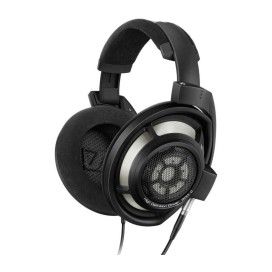
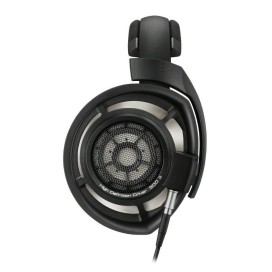
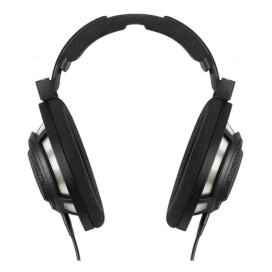
Combining the care of a handcrafted instrument and the precision of modern manufacturing, the HD 800 S allows you to explore your entire music collection from the inside out.
Open-back reference over-ear with exceptional soundstage and natural imaging

The HD 800 S deliver a mesmerizing sonic panorama that feels like stepping into the recording studio.
That’s no accident: it’s the result of countless deliberate design choices. The drivers are mounted at a precise angle to direct sound into the ear’s natural bend. Instead of a presentation that forms “between your ears,” you get a vivid flow of frequencies and transients that engages the senses.
In the end, the anti-vibration frame, carefully tuned transducer system, and open architecture work together to deliver one of the most convincing soundstages available. The imaging can rival — and in some setups even surpass — loudspeaker systems that cost exponentially more, especially once room acoustics are taken into account.
With the HD 800 S, your personal concert hall is always within reach — without waking the neighbors.

Powered by a high-performance transducer with remarkable range.
Achieving source-faithful acoustics also means dealing with complex frequency clusters that can create unwanted masking. That’s why Sennheiser integrates a patented frequency absorber — based on a similar principle used in the groundbreaking IE 800S — to reduce resonances that can obscure exceptional musical detail.
Additionally, the transducer system is mounted in an anti-vibration frame using aerospace-grade materials. Together with the headband structure, problematic low-frequency energy peaks are controlled to reveal the hidden purity of your hi-fi chain.
A high-performance transducer with wide bandwidth is only one part of the HD 800 S concept.
True-to-source reproduction also requires controlling complex frequency interactions that lead to masking effects. The patented absorber helps reduce resonances so subtle musical information stays intact and audible.
The anti-vibration frame further stabilizes the driver assembly, while the headband helps manage lower-frequency energy peaks — sharpening clarity and preserving tonal purity.
_2.jpg)
The HD 800 S are built for long-term comfort — for listening sessions as effortless as they are immersive.
Every contact point is lined with exceptionally soft microfiber padding, while carefully selected materials reduce weight and unwanted pressure. Each ear cup offers dual-axis adjustment: once you put them on, the HD 800 S quickly and naturally adapt to your individual head shape, keeping comfort and precision equally high.
| Frequency response | 4 Hz – 51,000 Hz |
| Sound pressure level (SPL) | 102 dB (1 V) |
| Impedance | 300 Ω |
| Total harmonic distortion (THD) | < 0.02 % (1 kHz, 1 Vrms) |
| Cable length | 3 m |
| Adapter / plugs | Stereo jack: 1/4" (6.35 mm), unbalanced, 3-pin 4.4 mm, balanced, 5-pin |
| Transducer principle | dynamic, open |
| Weight | 330 g |
| Ear coupling | circumaural |
| Magnetic field | 10.5 mT |
| Article number (SKU) | 506911 |

The dashed black line represents the Harman target, a reference frequency response developed based on consumer preferences. The red line represents the measurement of the HD800S. In practice, it shows how much the headphone’s frequency response deviates from the target. However, note that the target is highly smoothed, and it is not necessary to strictly adhere to the Harman target for a headphone to sound good.
Bass
The bass quality is what you would expect from a reference headphone: clean, tight, well-defined, and responsive. Transient response is sharp but not overly sharp. Decay is fast, and notes do not linger excessively.
Mids
Both male and female vocals perform equally well, and there’s an exceptional sense of clarity in the midrange that effortlessly tackles any instrument it comes across.
Treble
The original HD800 is infamous for its treble peak around 6 kHz, and an ingenious member of the community found a way to tame it (SDR mod). Sennheiser took note of this mod’s reception and developed the HD800S to address the treble issue. This can be seen in the frequency response graph: around 6 kHz, there is a slight bump, but it’s not a sharp peak. Finally, the treble extension provides an airy and spacious sound.
Harman Research
The Perception and Measurement of Headphone Sound Quality – What Do Listeners Prefer?